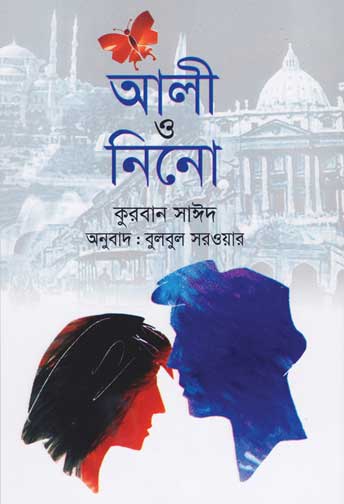
"Ali & Nino" by Kurban Said
Covers of editions published in 37 languages
The Azerbaijan International
Collection - 2014
Albanian
Arabic
Azeri
Bengali
Bulgarian
Catalan
Chinese (Taiwan, 2010)
Chinese (PRC, 2007)
Czech
Danish
Dutch
English
|
Finnish
French
Georgian
German
Greek
Hebrew
Hungarian
Indonesian
Italian
Japanese
Korean
Lithuanian
|
Norwegian
Persian
Polish
Portuguese (Brazil)
Portuguese (Portugal)
Romanian
Russian
Serbian
Slovenian
Spanish
Swedish
Turkish
Urdu
|
Also: (1) English (Braille, Talking Books for Blind and
Dyslexic, and Large Print)
and (2) Swedish (Talking Books for the Blind)
Who wrote Azerbaijan's Most Famous Novel - "Ali and Nino"?
Entire issue Azerbaijan International, Vol 15:2-4 (2011)

Albanian
2009
|

Arabic
1970
|

Arabic
2002
|

Arabic
2003
|
 Arabic Arabic
2010
|

Azeri
1972
|

Azeri
1990
|

Azeri
1993
|

Azeri
2004
|

Azeri
2004
|

Azeri
2006
|
 Azeri Azeri
2007
|
 Azeri Azeri
2008
|

Azeri
2010
|

Azeri
2012
|

Bengali
1995
|

Bengali
2003
|

Bengali
2004
|
 Bengali Bengali
2008
|

Bulgarian
2010
|

Catalan
2001
|

Chinese
(PRC)
2007
|

Chinese
(Taiwan)
2010
|

Czech
1939
|

Czech
2006
|
 Danish Danish
2008
|

Dutch
1938
|

Dutch
1974
|

Dutch
1981
|

Dutch
1991
|

Dutch
2002
|

Dutch
2004
|

Dutch
2009
|

English
(US) 1970
|

English
(UK) 1970
|

English
(UK) 1971
|

English
(Canada)
1972
|

English
(US) 1990
|

English
(UK) 1990
|

English
(US) 1996
(proof)
|

English
(US) 1996
|

English
(US) 1996
(proof)
|

English
(US) 1996
|
English
2000
(large print)
|
 English English
(US) 2000
(proof)
|

English
(US) 2000
|

English
(UK) 2000
|

English
(US) 2013
(coming)
|

Finnish
1972
|

Finnish
2000
|

French
1973
|

French
1973
|

French
2002
|
 French French
2006
|

Georgian
2002
|

Georgian
2004
|
|

German
1937
ORIGINAL
|

German
1973
|

German
1973
|
 German German
1973
|

German
1973
|

German
1981
|

German
1989
|

German
1992
|

German
1994
|

German
2000
|

German
2001
|

German
2002
|

German
2003
|
 German German
2009
|

Greek
2002
|

Hebrew
2001
|

Hungarian
2002
|
 Indonesian Indonesian
2004
|

Italian
1944
|

Italian
2000
|

Italian
2003
|

Japanese
1974
|

Japanese
2001
|

Korean
2005
|

Lithuanian
2012
|

Norwegian
1972
|
 Norwegian Norwegian
2005
|

Persian
1983
|

Persian
1992
|

Polish
1938
|
 Polish Polish
1938
|

Polish
1938
|

Portuguese
2000
(Brazil)
|

Portuguese
2004
(Continental)
|
 Romanian Romanian
2013
|

Russian
1994
|

Russian
2002
|
 Russian Russian
2003
|
 Russian Russian
2004 |
 Russian
2004 |

Russian
2004
|
 Russian
2007 |
 Russian Russian
2008 |
 Russian
2010 |
 Serbian Serbian
2003
|

Slovenian
2008
|
 Spanish Spanish
1973 |
 Spanish Spanish
2000 |
 Spanish
2001 |
 Spanish
2012 |
 Swedish Swedish
1938
|
 Swedish Swedish
1938 |
 Swedish
1973 |
 Turkish Turkish
1971 |
 Turkish
2004 |

Turkish
2005
|
 Urdu
Urdu
1993 |
|
|
|
|
|
|
|
"Ali and Nino" is the story of an Azerbaijani youth
who falls in love with a Georgian princess. Essentially, the
book is a quest for truth and reconciliation in a world of contradictory
beliefs and practices - Islam and Christianity, East and West,
age and youth. Much of the novel is set in Baku's Old City (Ichari
Shahar) on the eve of the Bolshevik Revolution in 1918. The novel
was first published in 1937, in a foreign country (Austria),
in a foreign language (German), by someone using the pen name
of Kurban Said (Gurban Said, in Azeri).
Unfortunately, the cover artwork for the various editions of "Ali and Nino" too often perpetrates stereotypes
about the Caucasus. For example, the narrative makes only slight mention
of camels, yet they often appear on the cover. Istanbul does
not figure into the action, but Hagia Sophia is used to represent
Islam. Ali describes his princess as "the most beautiful
girl in the world with the most beautiful nose and slim - far
too slim for the taste of the Orient." Perhaps the artists
didn't read that part.
Often a young girl is featured on the
cover, though the strongest character development comes through
the eyes and voice of Ali, a very sensitive, searching lad, not Nino. And though Ali loses his life in battle against the oncoming Bolsheviks, it's still hard to imagine him with
a turban on his head as warrior. Turban?!
For guidelines for collecting this book,
see "How
to Collect Kurban Said's Novel".
"Ali
& Nino Walking Tour,"
Summer 2004 issue (AI 12.2)
Purchase "Ali and Nino"
in English, Azeri or Russian. Search at Store (AZER.com).
© Azerbaijan International. All rights reserved.
Other Related Articles
1 Who Wrote Azerbaijan's Most Famous Novel "Ali and Nino"?
Entire edition of Azerbaijan International, Vol. 15:2-4 (2011)
2 What people are saying about the research by Azerbaijan International
about the authorship of "Ali and Nino." Vol. 15:2-4 (2011)
3 Review: Paul Goble: "Not Just a Question of Authorship: A Literary Excavation
into "Ali and Nino" (AI 15:2-4)
4 Editorial:
The World of "Ali and Nino" It's Our World too! Betty Blair (AI 12.2)
5 Review:
Inside the Soul of a Caucasian Elin Suleymanov (AI
12.2)
6 Baku
City Tour: "Ali and Nino" Walking Tour - Fuad Akhundov
and Blair (AI 12.2)
7 Photo
Essay: Then & Now: Baku 100 Years Ago at the Peak of Oil
Baron Period (AI 12.2)
8 Article:
How to Collect Kurban Said's Novel "Ali and Nino" Betty Blair (AI 12.3)
9 Letter
to Editor: Copyright - Leela Ehrenfels (AI 12.4)
10 Letter:
"Ali & Nino" Rediscovered - Ismail Kafescioglu
(AI 10.3)
Drama of "Ali & Nino" (English)
contact Ned Bobkoff: <nedbobkoff@msn.com>
AI Home | Magazine
Choice
| Topics
| AI Store | Contact us
Other Web sites
created by Azerbaijan International
AZgallery.org | AZERI.org | HAJIBEYOV.com
|